

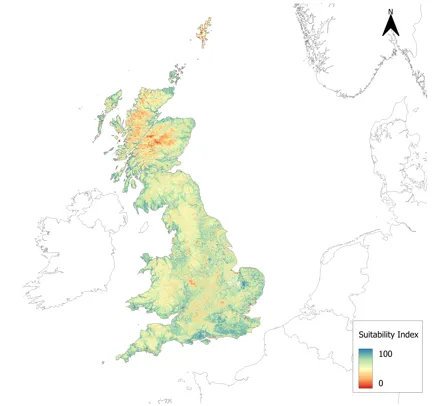
Pine marten suitability map_Britain
A new approach to mapping habitat
Drawing from data across Europe for the first time, the research shows that pine martens are most likely to thrive in landscapes with extensive woodland cover, while urban areas and intensively farmed arable landscapes provide poor habitat.
Substantial areas of highly suitable habitat have been identified across South East England, and wooded parts of the South West, Gloucestershire, East Yorkshire, East Anglia, South West Scotland, and sections of Britain's western coast.
Lead author, Ella Lewis, Nature Based Solutions and Evidence Officer for Kent Wildlife Trust said: “These new findings present the exciting potential for pine martens to return to their former range in the future, bringing with them habitat benefits such as seed dispersal and helping to balance and boost woodland ecosystems.
In using data from all over Europe, we’ve been able to predict the best habitat suitability for pine martens here in Britain, and now we have a more complete understanding of where this special species could potentially do well beyond the areas where remaining populations have survived or already been reintroduced.”
Helping restore a missing native species
The pine marten was once common throughout Britain but suffered dramatic declines during the 19th century caused by woodland loss and persecution. Today, they remain largely confined to Scotland, with small, fragmented populations in England and Wales, where they are Critically Endangered and a priority species for conservation.
As an important woodland predator, pine martens create complex interactions with other animals, contributing to more balanced and resilient ecosystems that support a greater diversity of wildlife. They also disperse seeds on their fur enabling plants to spread and are an indicator of healthy, connected woodland habitats.
The research forms a key part of the South East Pine Marten Restoration Project’s feasibility work exploring the potential for pine martens to recover in South East England. The Project is a partnership led by Kent Wildlife Trust and Wildwood Trust, with Sussex Wildlife Trust, The Conservators of Ashdown Forest and Forestry England.
Suzanne Kynaston, Wildwood Trust’s Co-Lead for the Project said: “This research is a crucial step in building our understanding of what a future for pine martens in the South East could look like. We are very encouraged to see substantial areas of suitable habitat identified across the region. Our feasibility work will bring together evidence on habitat and connectivity, alongside understanding the views of local communities and stakeholders, to assess whether pine martens could thrive in this landscape. This study gives us an invaluable foundation for our feasibility work to progress.”
Understanding where suitable habitat exists is a vital first step in assessing whether future reintroductions could be successful. Reintroduction projects in the Forest of Dean, Wales, Dartmoor, Exmoor, and the Lake District are demonstrating that carefully planned and evidence-led releases can bring pine martens back from the brink.
Supporting pine marten recovery
Is Britain still great for pine marten? A habitat suitability assessment