
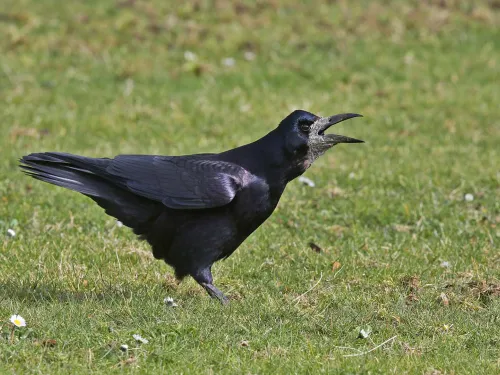
Rook
The all-black rook is a sociable bird, so can be spotted in flocks or nesting colonies, known as 'rookeries'. Unlike the similar carrion crow, it has a grey bill and 'baggy trouser' feathers around its legs.
Want to learn more about wildlife near you? You're in the right place, search below and discover the nature you can help protect in Kent.
The all-black rook is a sociable bird, so can be spotted in flocks or nesting colonies, known as 'rookeries'. Unlike the similar carrion crow, it has a grey bill and 'baggy trouser' feathers around its legs.
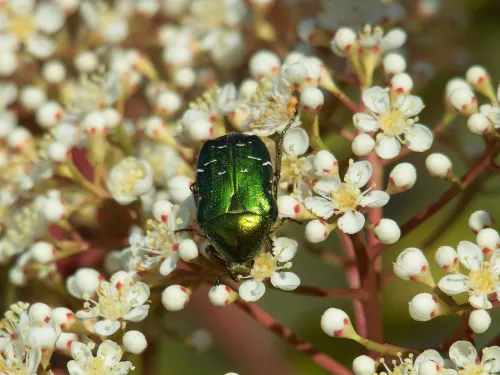
The rose chafer can be spotted on garden flowers, as well as in grassland, woodland edges and scrub.
A tall plant, Rosebay willowherb is a successful coloniser; it can form dense stands of bright pink flower spikes on disturbed ground, such as woodland clearings, verges and waste ground.
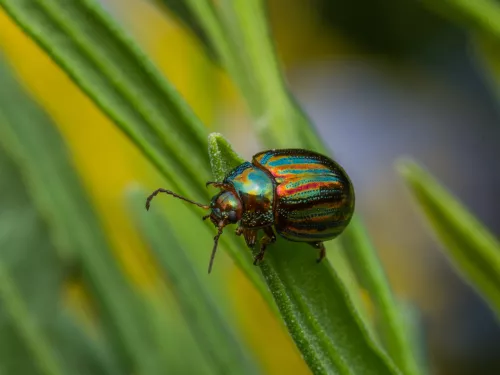
This beautiful beetle only arrived in the UK in 1960s but is now a common sight on garden herbs.
A 'weed' of cultivated and disturbed ground, Round-leaved fluellen is a trailing plant with round leaves and yellow flowers that appear over summer.
The carnivorous lifestyle of the round-leaved sundew makes this heathland plant a fascinating species. The round leaves have sticky, 'dew'-covered tendrils that tempt in unsuspecting insects as prey.
Often a lone figure on a windswept mountainside or heath, the Rowan tree can stand for up to 200 years. It is well known for its masses of red berries that attract all kinds of birds, including thrushes.
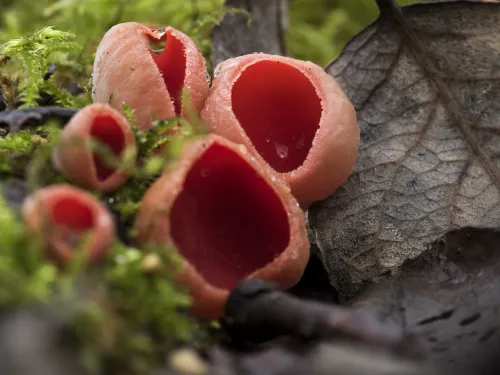
As its name suggests, the ruby elfcup is a bright red, cup-shaped fungus. It is widespread, but scarce, and can be found on fallen twigs and branches, particularly in areas with higher rainfall.
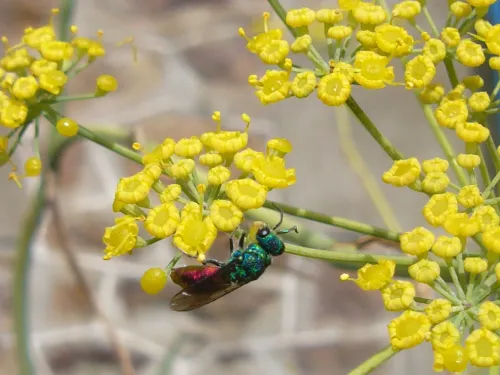
If seen up close, the glittering Ruby-tailed wasp is, perhaps, one of the UK's most beautiful insects. A solitary wasp, it can be found in sandy and rocky habitats like quarries, outcrops and walls.
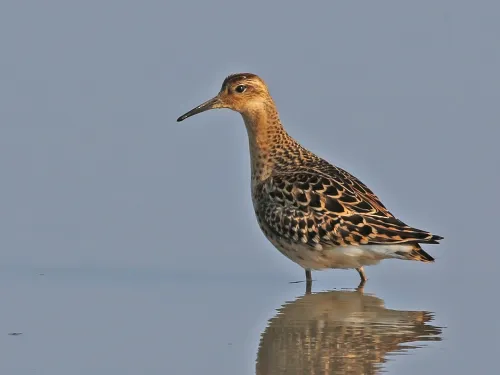
The UK hosts a small, but important, breeding population of ruff. The ruff is a large sandpiper that is so-called due to the large ruff of feathers around the males' neck. This is used in a showy display to attract a mate.
A low-growing herb of chalk and limestone grassland, Salad burnet lives up to its name - it is a popular addition to salads and smells of cucumber when crushed!
Sand eels are a hugely important part of our marine ecosystem. In fact, the fledgling success of our breeding seabirds entirely depends on them.